
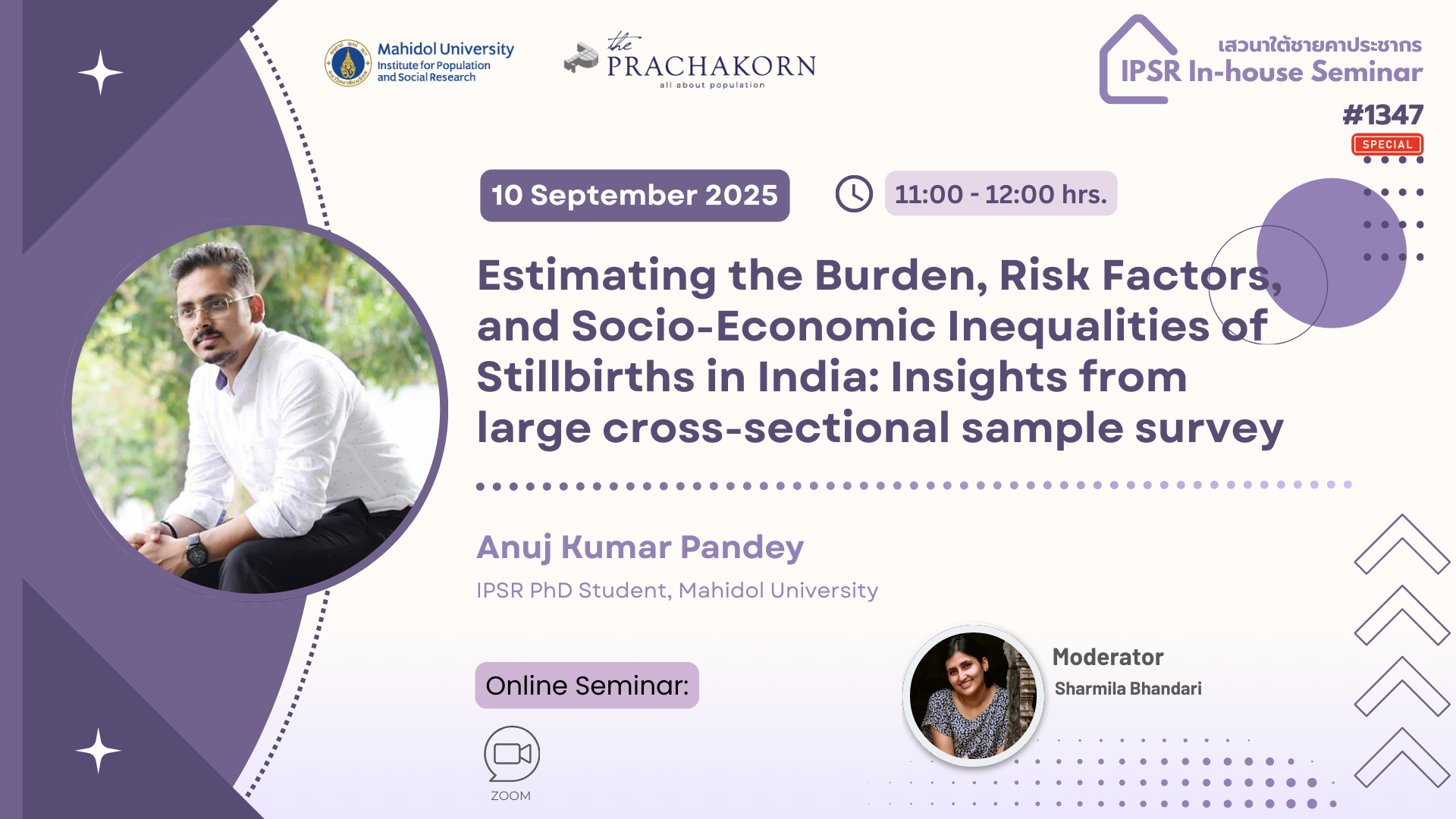
Seminar no. 1347 (Special)
10 September 2025 Time: 11:00 – 12:00 hrs.
Speaker: Anuj Kumar Pandey (IPSR PhD Student, Mahidol University)
Stillbirth remains a significant global burden, India being on the top with maximum contribution to the global stillbirth burden. This study aims to comprehensively examine the burden stratified by three gestation period cut-offs: ≥20 weeks, ≥22 weeks, and ≥28 weeks, risk factors, and wealth based socio-economic inequalities associated with stillbirths in India, Using data from the Demographic and Health Survey (DHS) 2019-21, the study has three specific objectives. First, estimated the burden of stillbirths at the three gestational age cut-offs at National, State and District level further calculating the Spatial autocorrelation in terms of Moran’s I statistics. Second, assessed key risk factors contributing to stillbirths in India, by using Propensity Score Matching (PSM) to ensure robust estimates by addressing potential confounders. Study also calculated population attributable fraction of each identified risk factor. Third, the study examined socio-economic inequalities in stillbirths by calculating the concentration index and visualizing disparities using the concentration curve. Further, Wagstaff decomposition analysis is used to break down the concentration index, attributing observed inequalities to specific socio-economic determinants. An analysis of 542,359 women who delivered in the five years preceding the three survey rounds (2005–06, 2015–16, and 2019–21) yielded stillbirth rates (SBR) of 12.8, 16.2, and 22.0 per 1,000 total births at ≥28, ≥24, and ≥20 weeks of gestation in India, respectively. Further, it was noted that during 2019–21, the Stillbirth Rate (SBR) in 14 out of 37 States/UTs (37.8%) was above the national average. Statistically significant clustering was observed in approximately 143 districts during 2015–16 and 157 districts during 2019–21. The district wise Global Moran’s I for SBR is estimated at 0.213 and 0.180 during 2015-16 and 2019-21, indicating a moderate positive spatial autocorrelation. Results from the PSM analysis revealed notable differentials in the effect of selected modifiable risk factors. Birth order and high risk fertility behavior emerged as the strongest determinant. Result from PAF analysis indicates that addressing key modifiable risk factors could substantially reduce the burden of stillbirths in India assuming causality as one of the biggest assumptions. Lastly study reported that stillbirth is largely concentrated amongst urban poor women (-0.20 during 2015-16 to -0.19 during 2019-21). Taken together, the findings suggest that inequality in stillbirths in India is primarily shaped by rural disadvantage, maternal risk characteristics, and poor access to healthcare, alongside marked regional disparities, particularly in the Eastern and Central parts of the country. By adopting a multi-faceted approach, this study provides critical insights into the burden and drivers of stillbirths in India. The findings highlight the role of socio-economic inequalities in shaping these outcomes, offering evidence for targeted public health interventions. The findings of the study also contribute to filling existing gaps in understanding stillbirths across different gestational periods at national, state and district level, advancing evidence-based policy-making, and prioritizing interventions to reduce stillbirths and associated disparities in India.
Join Zoom Meeting https://zoom.us/j/97651665495?pwd=n9lFXh6EaKDB42qEEOhsbLzvlElqMX.1
Meeting ID: 976 5166 5495
Passcode: 853648

