
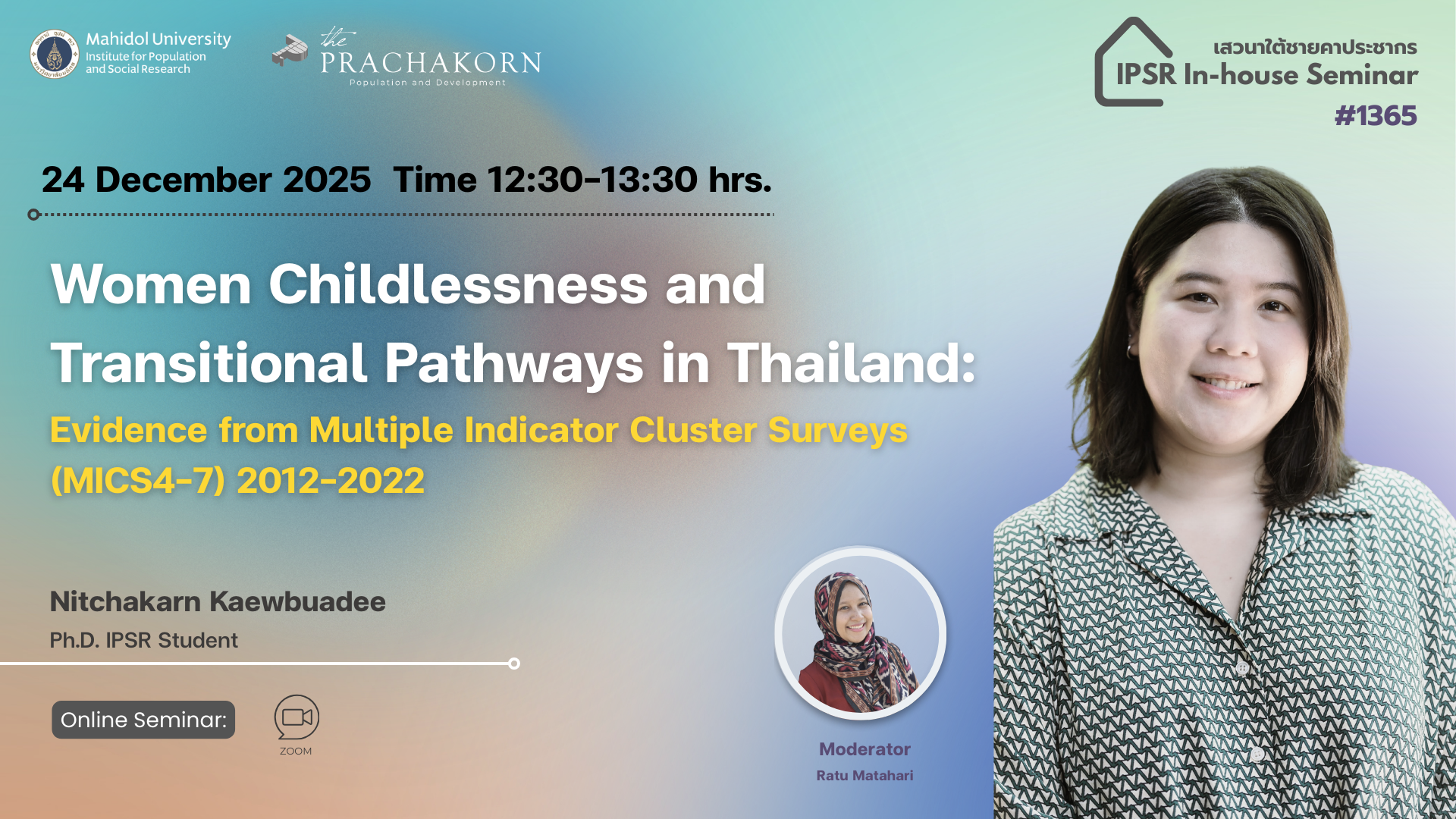
Seminar no. 1365
24 December 2025 2025 Time: 12:30 – 13:30 hrs.
Speaker: Nitchakarn Kaewbuadee (Ph.D. IPSR Student)
Thailand’s fertility rate has remained below replacement levels for decades. Like many low-fertility countries, Thailand is experiencing an increase in childlessness, indicating a significant demographic shift characterized by persistently low fertility rates. This study examines recent trends and socio-demographic patterns of childlessness by classifying childless women as voluntarily, involuntarily, temporarily, and permanently childless. The analyses utilize four rounds of nationally representative data from the Thailand Multiple Indicator Cluster Surveys conducted between 2012-2022. The study focuses on women aged 15-49, regardless of marital status, who were not pregnant during the survey. Preliminary findings indicate that the level of childlessness increased from one-third in 2012 to nearly 46% by 2022, with permanent childlessness increasing from around 6% in 2012 to around 8% in 2022. The Thai context is distinguished by a significant proportion of temporary childlessness, which accounts for approximately three-quarters of childless women in 2022. Temporary childlessness is associated with higher educational attainment, non-union status, and urbanity, suggesting the postponement of childbearing. To investigate these transitional dynamics, the study has mapped out potential pathways within the temporarily childless group. This analysis employs Latent Class Analysis (LCA) to classify distinct pathways, subsequently the study will incorporating a qualitative component that investigates socio-behavioral factors influencing reproductive decision-making.
Join Zoom Meeting
https://zoom.us/j/91913393673?pwd=VZSvOyY7UobdOaUrO6KK6T81aYn8Bj.1
Meeting ID: 919 1339 3673
Passcode: 974880

